Acceptance and Commitment Therapy (ACT)
This approach helps people relate differently to difficult thoughts and feelings by building acceptance, awareness, and values-based action. It’s commonly used for concerns like anxiety, depression, stress, trauma, and life transitions.
What is Acceptance and Commitment Therapy (ACT)?
Acceptance and Commitment Therapy is a skills-based approach that focuses on increasing psychological flexibility—the ability to stay present, open, and engaged even when experiences are uncomfortable. Instead of trying to eliminate difficult thoughts or emotions, ACT helps you change how you respond to them.
It draws from mindfulness and behavioral science, emphasizing acceptance, cognitive “defusion” (stepping back from thoughts), and identifying personal values. Compared to more traditional cognitive approaches, ACT spends less time challenging thoughts and more time changing your relationship to them.
Many people find it helpful for building a life that feels meaningful, even when challenges are still present.
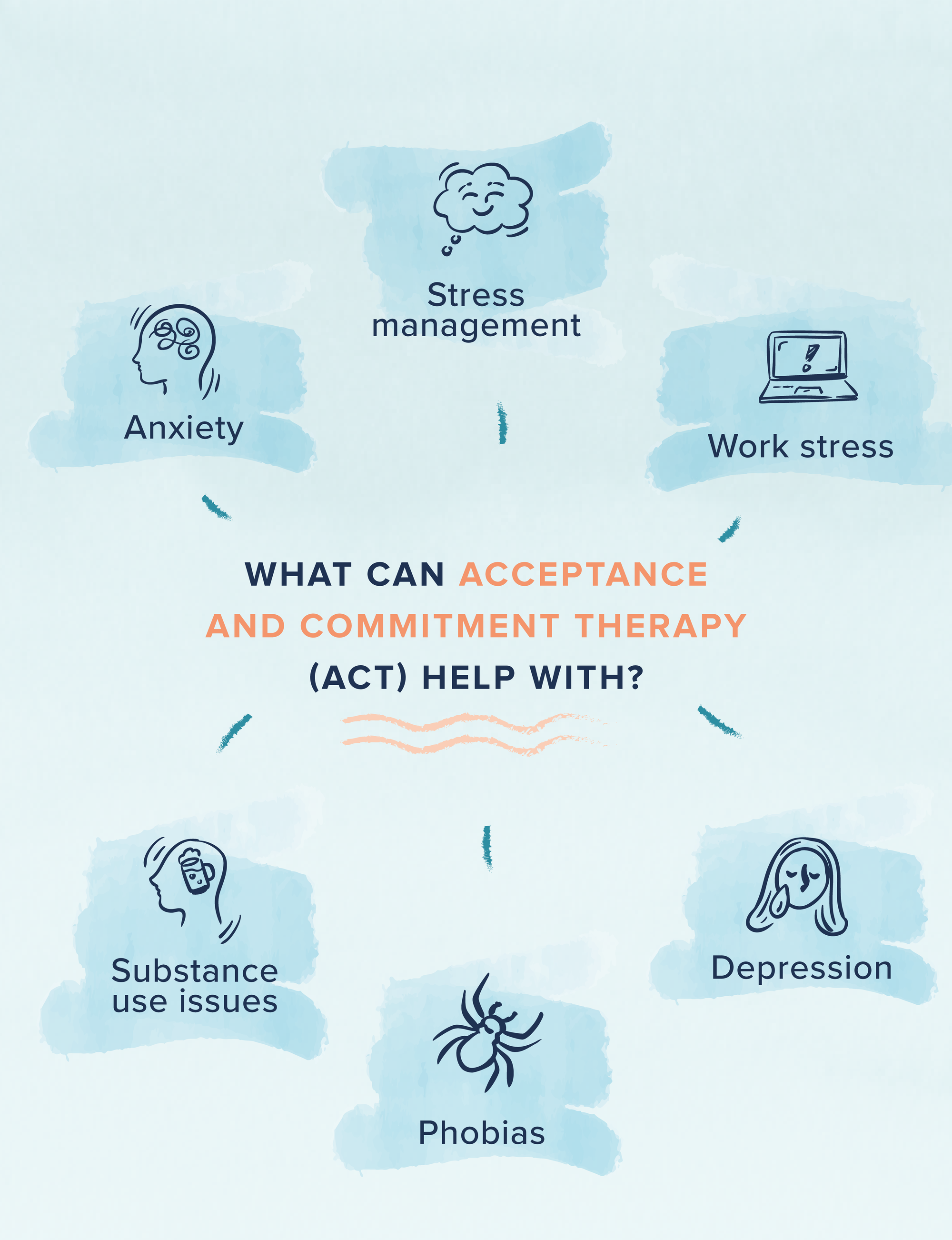
What issues Acceptance and Commitment Therapy (ACT) helps with
ACT can be helpful for a broad range mental health concerns, including:
This approach helps people relate differently to difficult thoughts and feelings by building acceptance, awareness, and values-based action. It’s commonly used for concerns like anxiety, depression, stress, trauma, and life transitions.
Signs you might need Acceptance and Commitment Therapy (ACT)
ACT may be a good fit if you’re feeling stuck in patterns of avoidance or struggling with difficult internal experiences.
Common signs include:
- You spend a lot of energy trying to control or avoid thoughts and feelings
- You feel stuck, even after trying to “think your way out” of problems
- Difficult emotions keep showing up despite your efforts to push them away
- You feel disconnected from what matters most to you
- You want to live more in line with your values, but aren’t sure how
- You notice self-critical or repetitive thoughts that are hard to let go of
- You’re open to mindfulness-based or experiential exercises
When to consider getting help
It may be time to seek support if:
- Avoidance is limiting your choices or opportunities
- You feel caught in ongoing inner struggle with thoughts or emotions
- You’re unsure what direction feels meaningful or fulfilling
- Stress or emotional pain is affecting daily functioning
- You want a different way of relating to difficult experiences, not just reducing them
What happens in a typical Acceptance and Commitment Therapy (ACT) session
ACT sessions are collaborative and experiential, often blending conversation with exercises:
- Check-in: You discuss recent experiences, challenges, and patterns you’ve noticed.
- Clarify focus: You identify a situation or internal struggle to explore.
- Explore patterns: Your therapist helps you notice how thoughts, emotions, and avoidance patterns are interacting.
- Practice an ACT skill: This might include mindfulness, defusion exercises, acceptance techniques, or values clarification.
- Connect to values: You explore what matters to you and how your actions align (or don’t) with those values.
- Plan committed action: You identify small, meaningful steps you can take, even in the presence of discomfort.
How long Acceptance and Commitment Therapy (ACT) usually takes
ACT is often practiced weekly at the beginning, especially while learning new skills.
Some people use it as a shorter-term approach focused on a specific issue, while others continue longer to deepen values-based living. The timeline depends on your goals, the challenges you’re facing, and how much support you want over time.
What to look for in an Acceptance and Commitment Therapy (ACT) therapist
When looking for an ACT therapist, it can help to find someone who:
- Has specific training or experience in ACT, not just general therapy
- Is comfortable guiding experiential exercises, not just conversation
- Helps you explore values in a practical, personalized way
- Balances acceptance with meaningful behavior change
- Works at a pace that feels manageable, especially with difficult emotions
- Can explain concepts like defusion and acceptance in clear, relatable terms
Fit matters. It’s okay to ask how a therapist uses ACT and to try another provider if the approach or connection doesn’t feel right.
Acceptance and Commitment Therapy insights
Hundreds of studies have found Acceptance and Commitment therapy to be an effective therapy approach for a range of conditions.
Acceptance and Commitment therapy (ACT) has been shown to be particularly helpful for adolescents, perhaps even more so than Cognitive Behavioral Therapy (CBT).
Related therapies
Depending on your goals, you may also explore:
FAQ about Acceptance and Commitment Therapy
Does ACT really work?
ACT helps many people develop a different relationship with their thoughts and emotions, which can reduce struggle and increase flexibility. It’s especially helpful for those who feel stuck trying to control internal experiences.
How is ACT different from CBT?
While both are practical and skills-based, CBT often focuses on changing thought patterns, whereas ACT focuses on changing how you relate to thoughts and building a values-driven life.
How long does ACT take to help?
Some people notice shifts in how they respond to thoughts and emotions within a few months. Others continue longer to build and maintain values-based habits.
Can ACT be done online?
Yes. ACT translates well to virtual therapy, including guided exercises and discussions.
Do I have to do mindfulness in ACT?
Mindfulness is a core part of ACT, but it’s usually adapted to feel accessible and practical rather than rigid or time-intensive.
What if ACT doesn’t feel helpful?
It may mean you need a different pace, therapist, or approach. Other options like CBT, DBT, or psychodynamic therapy may be a better fit depending on your needs.
Find vetted therapists who practice Acceptance and Commitment Therapy (ACT)
- Alabama
- Alaska
- Arizona
- Arkansas
- California
- Colorado
- Connecticut
- Delaware
- Florida
- Georgia
- Hawaii
- Idaho
- Illinois
- Indiana
- Iowa
- Kansas
- Kentucky
- Louisiana
- Maine
- Maryland
- Massachusetts
- Michigan
- Minnesota
- Mississippi
- Missouri
- Montana
- Nebraska
- Nevada
- New Hampshire
- New Jersey
- New Mexico
- New York
- North Carolina
- North Dakota
- Northern Mariana Islands
- Ohio
- Oklahoma
- Oregon
- Pennsylvania
- Puerto Rico
- Rhode Island
- South Carolina
- South Dakota
- Tennessee
- Texas
- Utah
- Vermont
- Virginia
- Washington
- Washington DC
- West Virginia
- Wisconsin
- Wyoming